
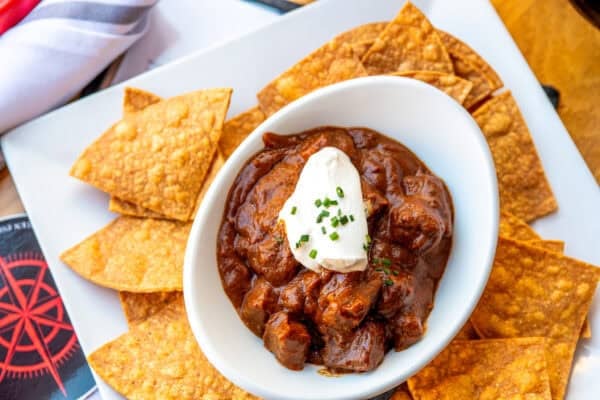
Chef, Judge, and Trophy-Winning Competitor Matt Welsch Explains How to Win Chili Competitions

I’ve stood on both sides of the chili table. I’ve judged more unsanctioned chili cook-offs than I can count, and this October I’ll judge one for West Virginia State Parks, where I serve as executive chef. I’ve competed, too. My team at Vagabond Kitchen, my restaurant in Wheeling, West Virginia, brought home a trophy in the Wheeling Feeling Chili Cook-Off every year we entered, including People’s Choice in 2014, 2015 and 2018, and Best in Wheeling in 2016. We often made more than 30 gallons, and my Texan Book of the Dead Chili is a crowd-pleaser at the restaurant.
Outside of chili, I’ve judged ProStart competitions for nine years at the state level and seven at the national level. ProStart is a culinary program for high school students, and those competitions are scored against a detailed rubric. In 2018, I won Food Network’s Guy’s Grocery Games. All of it taught me the same lesson. The scoresheet tells you what matters. Your palate tells you whether the cook delivered it.
So here’s what chili judges look for, and what separates a good bowl from a winning one.
How is Chili Judged?
Most cook-offs are judged blind. You hand over your chili in a numbered “turn-in cup,” and the judges never know whose chili they’re tasting. Beyond that, chili cook-off judging criteria vary by organization, so don’t assume the rules from one contest carry over to the next.
Chili Appreciation Society International (CASI): Judges give each cup a single score from 1 to 10. They weigh aroma, red color, consistency, taste, and aftertaste. Each judge tastes once. When the cup moves down the table, it’s gone. No beans and no fillers like rice or macaroni.
International Chili Society (ICS): Judges taste every cup and rank their top three. The official criteria call for tender meat, a balanced ratio of sauce to meat, a distinct chili flavor, and heat that’s “not bland and not too hot.” Garnishes aren’t allowed. Beans depend on the category. Traditional red and chili verde recipes ban them, whereas homestyle requires them.
Unsanctioned Cook-offs: These are the church, fire hall, and charity events, and they run on house rules. Many include a people’s choice award, where the public tastes and votes.
A “sanctioned” cook-off follows a governing body’s official rules and winning one can qualify you for that body’s championship. Before you buy a single pepper, read the rules for the contest you’re actually entering.
What Do Chili Judges Look For?
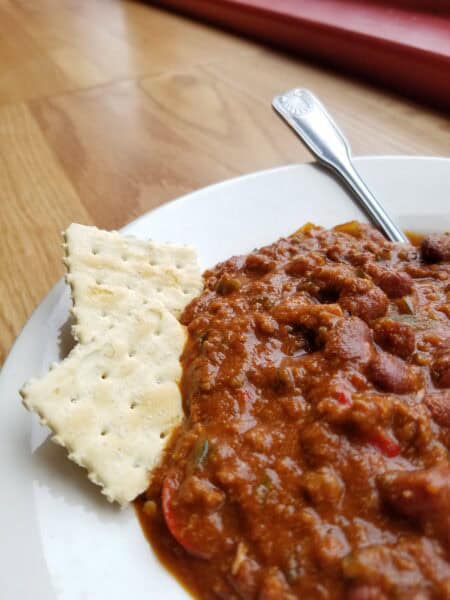
Viscosity: This is the first thing I notice. I want chili thick but not stew. It should be a little nappe. That’s a kitchen term for a sauce that coats the back of a spoon. Good chili coats the spoon, and then it coats your mouth. Soupy chili tells me it didn’t cook long enough.
Color: CASI scores red color as its own category, and even when it isn’t on the scoresheet, judges eat with their eyes first. If I’m looking at a red chili, I want to see a deep, dark red. The color of toasted rust. A red that’s too bright tells me the chili was rushed and probably lacks flavor. Too dark, and I wonder what burned.
Aroma: A chili can look like it’s hitting every mark, then fall flat once it hits your nose. If it isn’t good on the nose, it’s almost definitely not going to taste good. More often than not, that’s a salt problem.
Balance: Chili should be rich with good salt and acidity. Acid wakes everything up. Salt makes every other flavor show up for work.
Meat texture: The meat needs a good brown on it. It should be tender but still have some structure, some tooth. I want it to resist a little when I bite down, then melt as I chew. As for which meat, different categories call for different cuts. For best overall, I don’t care if it’s steak, chicken, or ground turkey. Chili is all about technique. Whatever you use, get the cut right. Not too dry, and not too fatty.
Heat: Spice is subjective, and that’s exactly why you shouldn’t gamble with it. Don’t blow out the judges’ palates. Unless the rules call for heat or you’re in a spicy category, make it hot enough that we know it’s there. Don’t make it so hot your grandma is chugging a gallon of ice-cold moo juice. Heat should support the chili. It shouldn’t stand out.
Competition Chili vs. Family Recipes
At home, you cook chili for yourself, your family, and your friends. At a competition, you cook for the judges. You have the criteria in front of you, and your job is to meet them the best you can. That can be a very small box to fit your chili into, but that’s the game. Your family recipe might be the best thing you make all winter, and it still might not fit the box. Competition chili is built for one spoonful in a plastic cup, tasted next to twenty others.
The Great Chili Debates
Beans or no beans? The rules settle this one, not you and not the judges. Check your category and the official rules. My personal take: I grew up with beans in my chili, and I’m all for them. I also love Texas-style chili. I’ll go further. A well-made vegetarian chili can beat a poorly made meat chili.
Does hotter chili score better? No. Unless you’re entering a category built around heat, a chili that scorches the judges’ palates is hurting itself, and it can hurt every cup tasted after it.
Do secret ingredients help? I don’t believe in secret ingredients. Anyone with a good palate will find yours. Plenty of unusual ingredients can add something special, as long as they serve the chili. Everything in the cup is on the same team. No one ingredient should steal the show.
The Bowl I Still Think About
One year at Wheeling Feeling, a few of us competitors were trading samples. One woman was very proud of her secret ingredient. I tasted her chili, looked at her, and said, “sour cream.”
She was floored. “No one’s ever guessed it before!”
“I didn’t guess,” I said. “I tasted it.”
That kind of palate takes years to build. Mine started at a coffee shop in Chicago. I was amazed when I began tasting the differences between roasts. After a few weeks, I could pick out light, medium, and dark. After a few months, I could tell Guatemalan from Honduran. Later I cooked at a cross-country ski lodge in Idaho, making gallons upon gallons of soup. That’s where I really learned flavors, and which ones belong together.
Point being, expect the judges to have a more seasoned palate than you’re used to. They’ve seen and tasted a lot. Good chili should be a revelation. It’s a harmony of very different parts working together, and that only happens when you know what you’re doing.
My Best Advice
Cooking should be fun, but I’m not going to tell you to just have fun. Pour your love of cooking chili into the pot and cook from that. Take risks. Try things. Cook a lot of chili, because it’s a skill that only get better with practice. And love every minute of it. Every bean. Every toot.
About the Author

Matt Welsch is a chef, writer, and the owner of Vagabond Kitchen, the elevated Appalachian comfort food restaurant he opened in Wheeling, West Virginia, in 2014. He also serves as Executive Chef for West Virginia State Parks, where he leads food and beverage across the state park system.
Before he settled in Wheeling, Matt spent years traveling and cooking wherever a kitchen would take him, from a Chicago coffee shop to a cross-country ski lodge in Idaho. He was raised on a West Virginia farm, and he uses food to tell stories and to lift up the farmers, producers and traditions of Appalachia.
He knows competition from both sides of the table. Matt won Food Network’s Guy’s Grocery Games in 2018 and took home two awards at the 2016 Cast Iron Cook-Off. His team earned a trophy every year it entered the Wheeling Feeling Chili Cook-Off. He has judged ProStart high school culinary competitions for nine years at the state level and seven at the national level, along with numerous local chili cook-offs. The Local Palate named him 2026 Best Chef of West Virginia, and WV Living Magazine has honored Vagabond Kitchen for Best Appalachian Cuisine and Best Brunch.
Keep reading

Keep reading

Chili Cook-Off Winner!
Congratulations to Shauna Havey on winning the CCC Chili Cook-Off with her "Mexican Street Corn Chicken Chili!"
Read article
Skinny Snacks: Smoked Salmon and Veggie Pinwheels
These "Smoked Salmon and Veggie Pinwheels" are satisfying, skinny snacks. They are a low-carb treat inspired by the classic bagel and cream cheese!
Read article
Tips for Recipe Contests – Week 4
The fourth and final week of sharing expert tips for recipe contests by Jean Sanderson in her book "Discover Contest Cooking."
Read article